

Abstract:
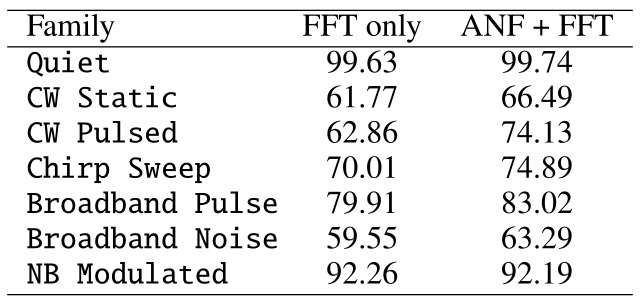
Radio-frequency interference (RFI) remains a significant threat to GNSS in safety-critical applications. Since no single mitigation method is effective for all interferers, reliable classification is needed to select appropriate countermeasures during operation. To prevent loss of lock, RFI classification must run in real time, typically on resource-constrained embedded platforms, necessitating lightweight algorithms. While prior works realize this with simple rule-based algorithms for detecting and characterizing certain types of interferers, this approach does not scale to the broad space of all possible RFI techniques, and data-driven learned algorithms are a better fit. To satisfy these constraints, this work considers pre-correlation RFI classification with an emphasis on compact algorithms that still provide high accuracy. We first introduce a new set of lightweight input features derived from the instantaneous frequency predictions of a virtual adaptive notch filter (ANF). We observe improved classification accuracy for both narrowband and broadband non-stationary RFI by combining these new features with other spectral features from prior literature. Next, we benchmark compact learned classifiers such as gradient-boosted decision trees for accurate prediction under tight compute and memory budgets. The evaluation spans a broad set of simulated and recorded RFI events, including publicly available datasets from recent studies. Finally, we measure resource utilization for our models and for representative methods from the literature, on a compact CRPA platform (EDGE Microwave HEDGE-8008).
Highlights:
- Virtual-ANF-based expert features complement conventional spectral (STFT) expert features, enabling extremely lightweight pre-correlation interference classifiers.
- The tuning of virtual ANF hyperparameters have minimal effect on classification performance, easing robust deployment.
- Virtual ANF features specifically excel in the detection of pulsed interferers, complementing the missing link in existing classification chains.