


Standard positioning GNSS receivers typically determine range from the modulated code spread on GNSS signal carriers where user accuracy is commonly meter class and depends on satellite geometry, atmosphere, multipath, supported bands/constellations and receiver implementation.
Real-Time Kinematics (RTK) technique exploits the much shorter carrier wavelength measurements by eliminating common error terms such as satellite clock errors, ephemeris errors and atmospheric delay variations in real-time. Removal of common error terms enable to resolve carrier-phase ambiguity therefore total carrier cycles between the satellite and receiver. Range calculation based on carrier wavelength can be used to achieve centimeter level positioning accuracy.
A conventional GNSS CRPA equipment suppresses interference by continuously changing complex weights across its antenna elements. Each calculated weight set changes the composite phase response presented at the RF output. Inconsistent phase variations across carrier-phase ambiguity solutions will result loss of RTK fix even when the CRPA is successfully suppressing the interference sources.
HEDGE CRPA series combine adaptive spatial suppression with proprietary phase stabilization algorithms. The null-forming weights remain free to form and adapt nulls, while the phase stabilization network compensates the carrier-phase disturbance introduced by array processing.
The resultant stable phase on RF output allows RTK GNSS receiver to keep centimeter level accuracy even under severe contested interference environment.
1. System Overview
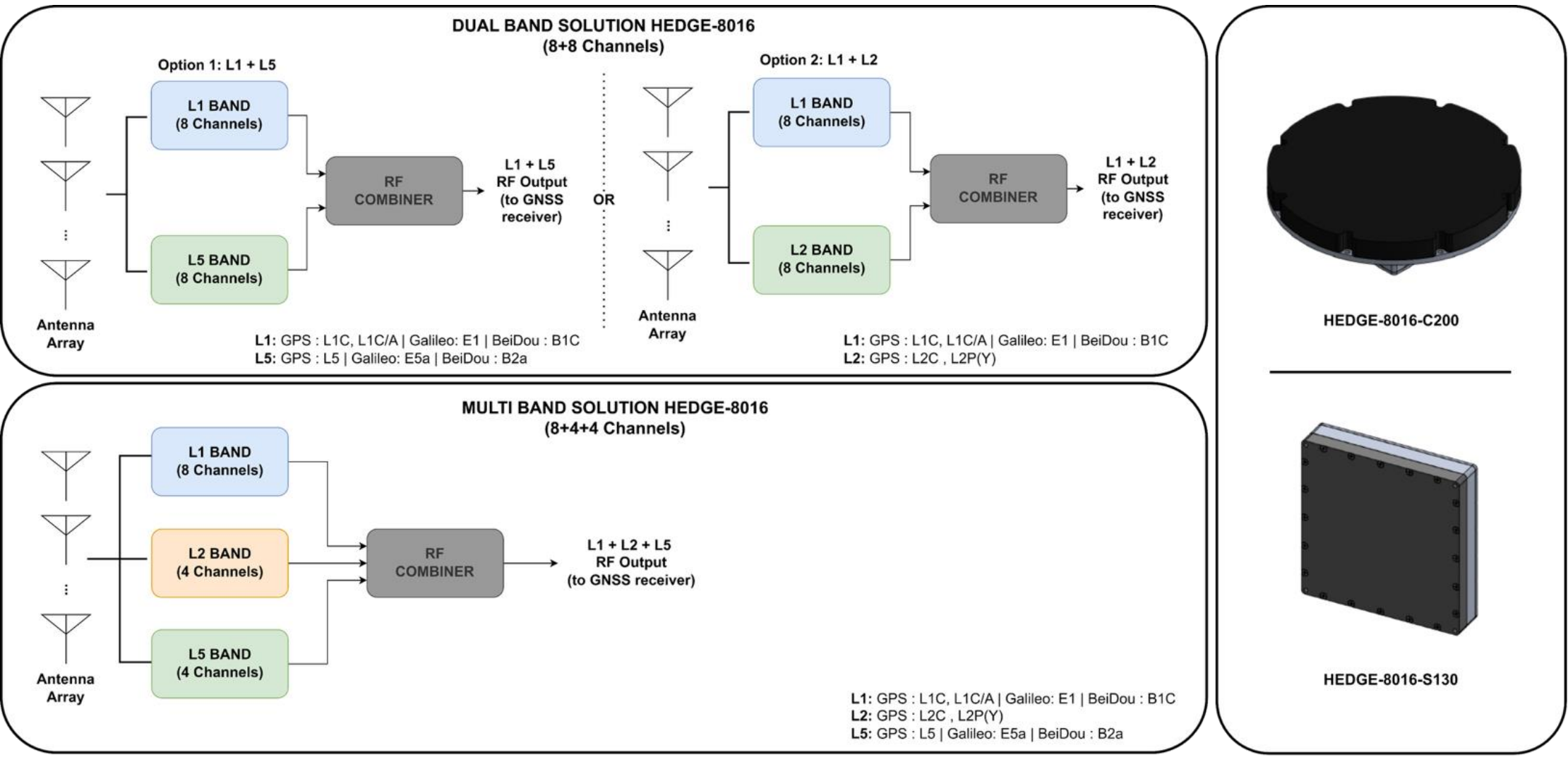
The proposed multi-band RTK-Enabled GNSS CRPA architecture provides independent spatial interference mitigation across the L1, L2, and L5 GNSS frequency bands while maintaining compatibility with external multi-band RTK GNSS receivers. Independent band-specific CRPA processing is applied to the received signals, and the interference-mitigated RF outputs are combined into a unified multi-band signal for GNSS positioning. RF and digital receive chains are designed to maintain low group-delay variation and high linearity, minimizing the distortion of the received waveform during reception and spatial filtering.
Stabilization of antenna phase response under interference is particularly important for receivers that exploit advanced GNSS processing techniques such as precise code and carrier-phase tracking, long coherent integration, and dual-frequency ionospheric correction. This combination of multi-constellation reception, spatial interference mitigation, and carrier-phase preservation enables the CRPA architecture to support modern centimeter-level high accuracy RTK positioning.
HEDGE-8016 C200: 8+8 Multi-Band CRPA
(L1 + L5 / L1 + L2)
Optimized for high-order spatial nulling and dense interference environments.
- Up to 7 independent nulls.
- Multi-Band Signal Reception:
- GPS: L1C, L1C/A, L2C,L5
- Galileo: E1 , E5a, E5b
- BeiDou: B1C, B1I, B2a, B2b
HEDGE-8016 S130: 8+4+4 Multi-Band CRPA
(L1 + L2 + L5)
Independent adaptive spatial processing on both wideband GNSS signals.
- Up to 7 independent spatial nulls (L1).
- Up to 3 independent nulls per band(L2 + L5).
- Multi-Band Signal Reception:
- GPS: L1C, L1C/A, L2C,L5
- Galileo: E1 , E5a, E5b
- BeiDou: B1C, B1I, B2a, B2b
2. RTK Positioning Principles
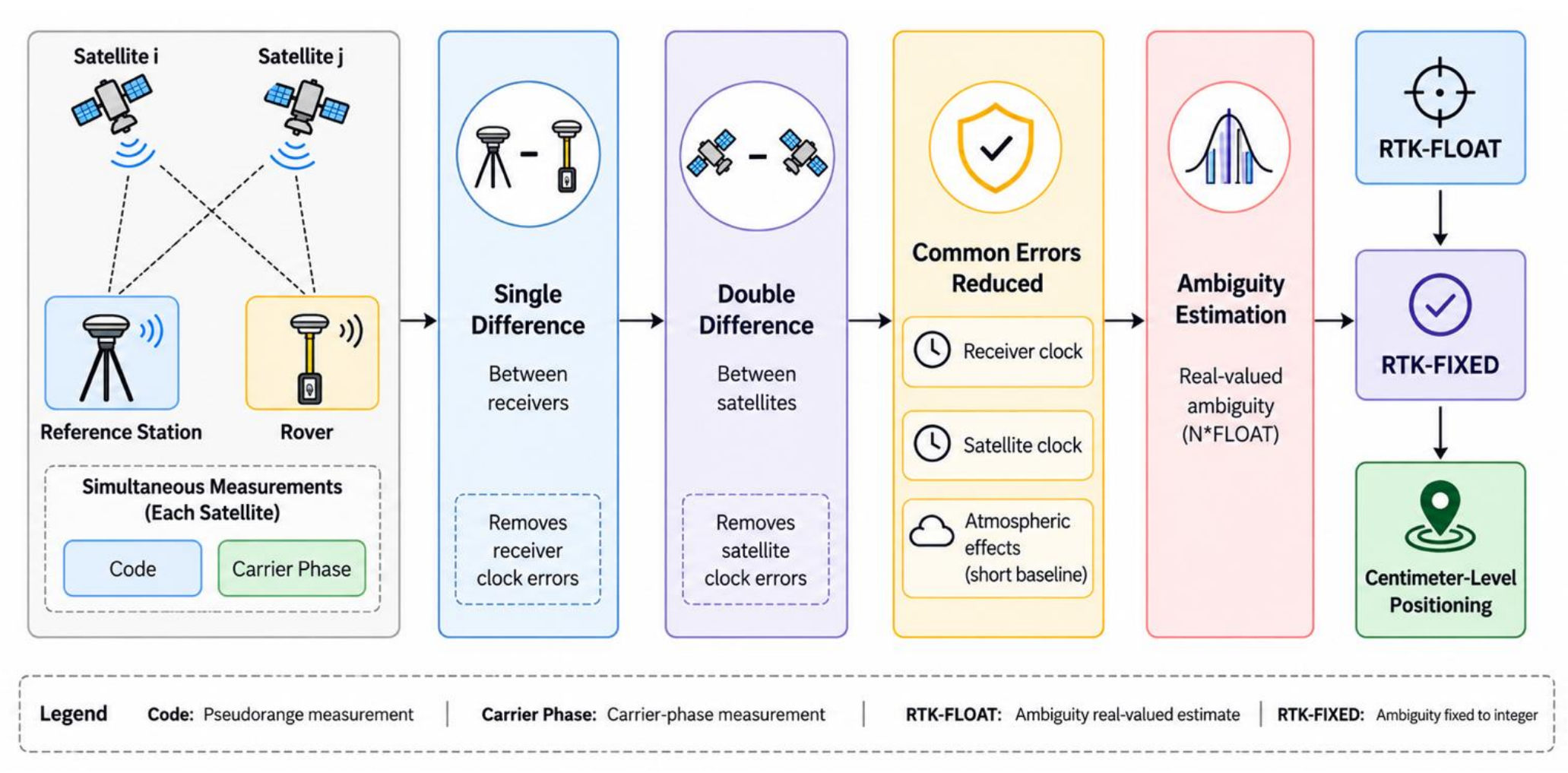
RTK is a carrier-phase based relative positioning technique that uses simultaneous GNSS observations from a reference station and a rover to achieve centimeter-level positioning accuracy.
The fundamental advantage of RTK comes from the high precision of the GNSS carrier-phase observable. Within the GNSS receiver, the incoming satellite carrier is tracked by a carrier-tracking loop, typically implemented using a Costas-Loop PLL. The tracking loop continuously estimates the phase of the received carrier relative to the receiver’s local oscillator and produces a precise carrier-phase measurement.
An important distinction is that the PLL does not directly determine the integer ambiguity. The carrier tracking loop provides an extremely precise estimate of the received carrier phase, including the fractional phase component. However, the absolute number of full carrier cycles between the satellite and the receiver is unknown.
RTK resolves this uncertainty by utilizing simultaneous carrier phase observations from both the rover and the reference station. The observations are differenced between the rover and reference receivers to eliminate or significantly reduce common sources of errors.
An integer ambiguity-resolution algorithm then estimates and validates the most probable integer ambiguity set. Once the ambiguities are successfully resolved the navigation solution transitions to RTK-FIX state, enabling centimeter-level relative positioning.
Maintaining RTK solution depends on the continuity and consistency of the carrier-phase measurements used for ambiguity resolution. This requirement is particularly important in CRPA-based GNSS systems, where multiple antenna and RF channels are coherently combined before the signal reaches the GNSS receiver.
3. Carrier-Phase Integrity in GNSS CRPA Systems
Carrier-phase integrity is a critical consideration when CRPA-based interference mitigation is used in conjunction with RTK positioning.
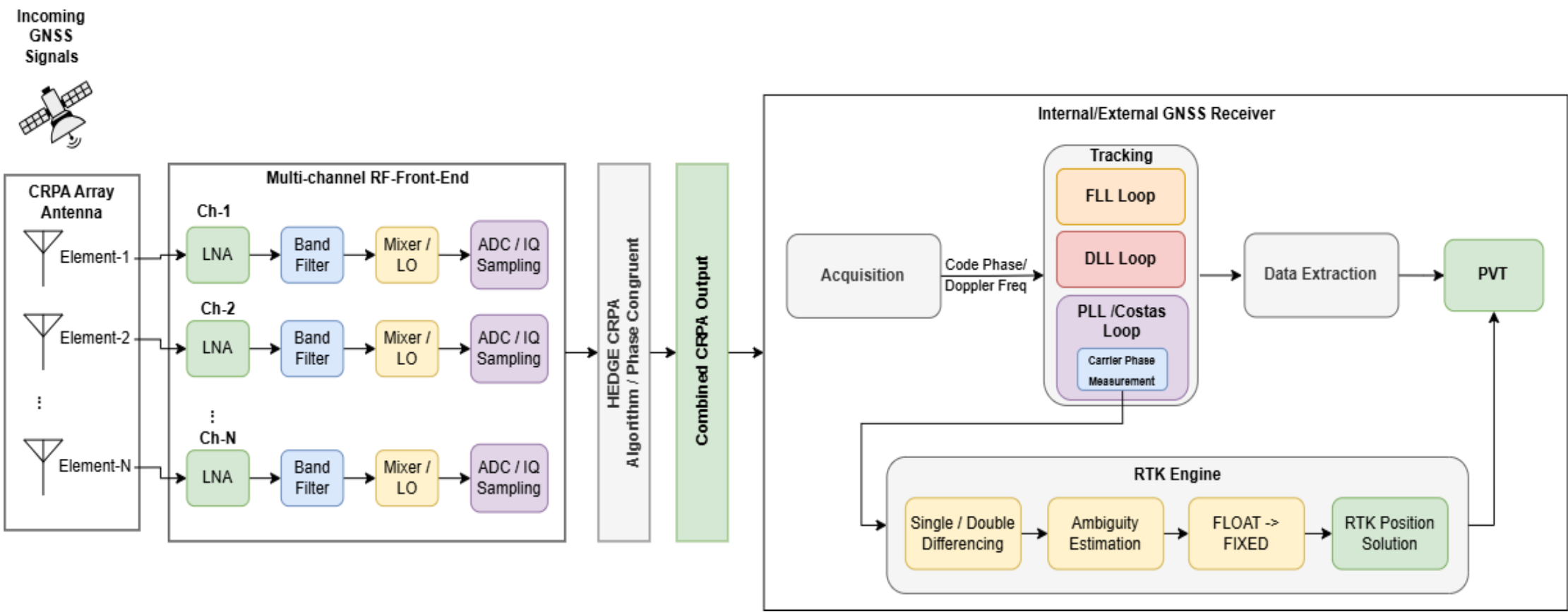
As illustrated in Figure 3, a conventional CRPA architecture processes the received signals through multiple antenna elements, independent RF channels, and adaptive spatial-processing stages before presenting a combined signal to the GNSS receiver.
In conventional CRPA implementations, uncompensated inter-channel phase offsets and time-varying phase responses introduced by adaptive beamforming alter the effective carrier phase of the combined GNSS signal. Although these variations have limited impact on conventional code-based positioning, controlling them is crucial for RTK, where centimeter-level positioning depends directly on stable carrier-phase observations and reliable integer ambiguity resolution .
If the effective CRPA phase response varies over time, the resulting phase changes may appear as additional biases in the carrier-phase measurements observed by the GNSS receiver. This can increase carrier-phase residuals, degrade ambiguity estimation, and reduce the continuity or robustness of the RTK solution, particularly when the interference environment causes frequent adaptation of the CRPA weights.
The HEDGE architecture addresses this limitation by proprietary phase stabilisation algorithm implemented within the null forming processing core. Preservation of carrier-phase integrity required by downstream RTK processing while simultaneously providing anti-jam protection enables the GNSS receiver to maintain carrier-phase tracking and supports centimeter-level RTK positioning in interference environments.
4. Interference Test Setup and Conditions
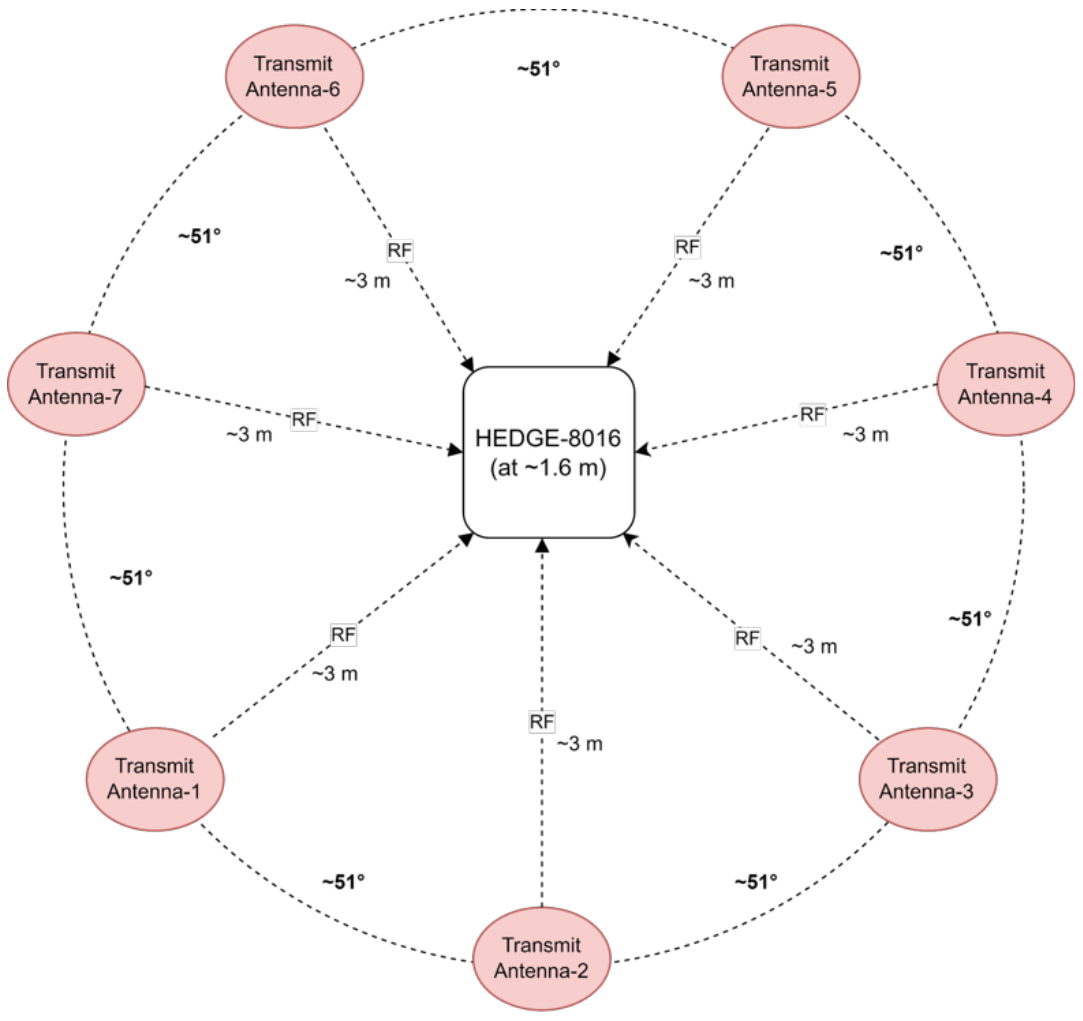
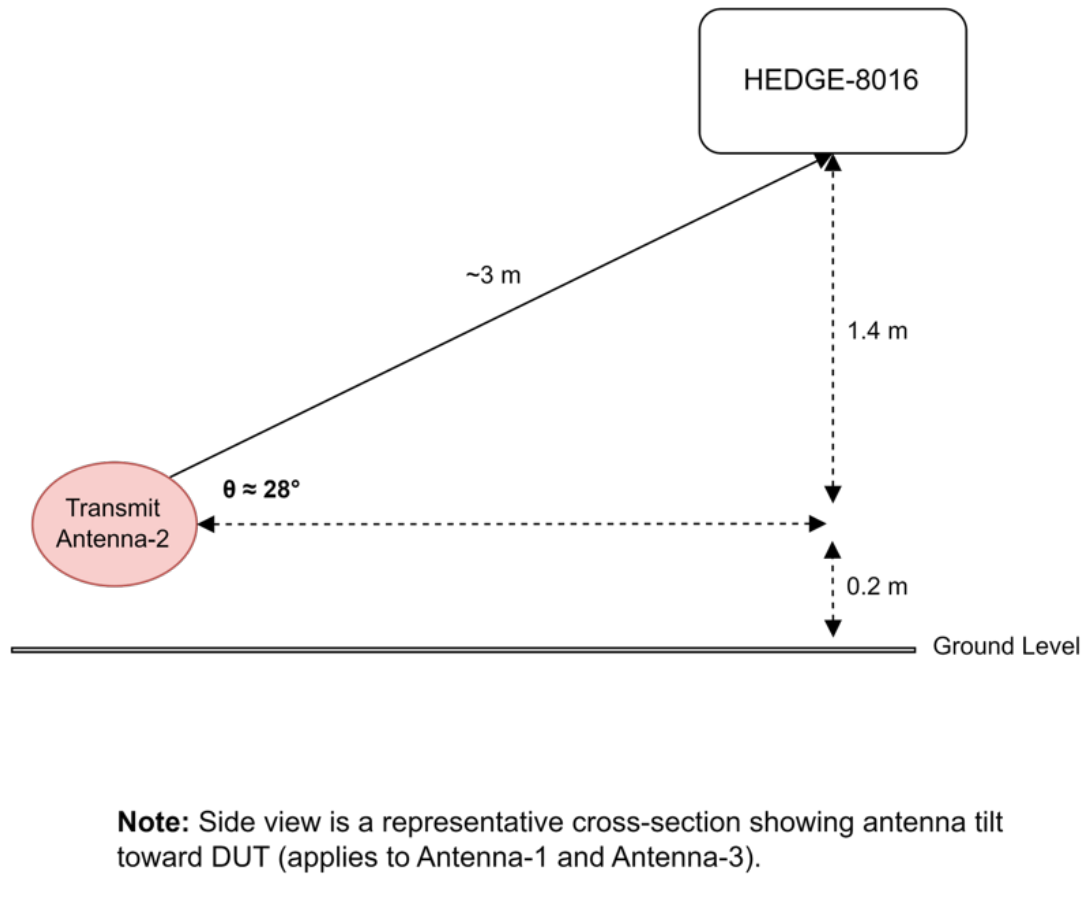
The experimental evaluation setup, illustrating the simulated interference environment, is shown in Figure 4 and Figure 5.
The test setup is designed to evaluate the positioning performance of the HEDGE-8016 under multi-directional, spatially distributed interference conditions, while keeping the receiver and CRPA configuration fixed. During the experiments, the average received interference power at the Device Under Test (DUT) was maintained approximately between −32 and −58 dBm, covering a range of significant interference conditions. As illustrated in Table 1, received interference levels in this range are representative of the levels that may occur at the DUT depending on jammer distance and radiated power.
The evaluation further includes a band-dominant interference condition in which the L1 signal is strongly suppressed. This edge-case scenario demonstrates the benefit of multi-band reception, as the L5 band remains available to support continued positioning despite severe L1-band interference. The corresponding positioning results are presented from Section 5 onward.
| Distance to Jammer (m) | Received Interference Level at DUT (dBm) | Equivalent J/S (dB) |
|---|---|---|
| 30 | ≈ −20 | 110 |
| 110 | ≈ −30 | 100 |
| 340 | ≈ −40 | 90 |
| 1000 | ≈ −50 | 80 |
| 2500 | ≈ −60 | 70 |
5. Multi-Band GNSS RTK Positioning Performance
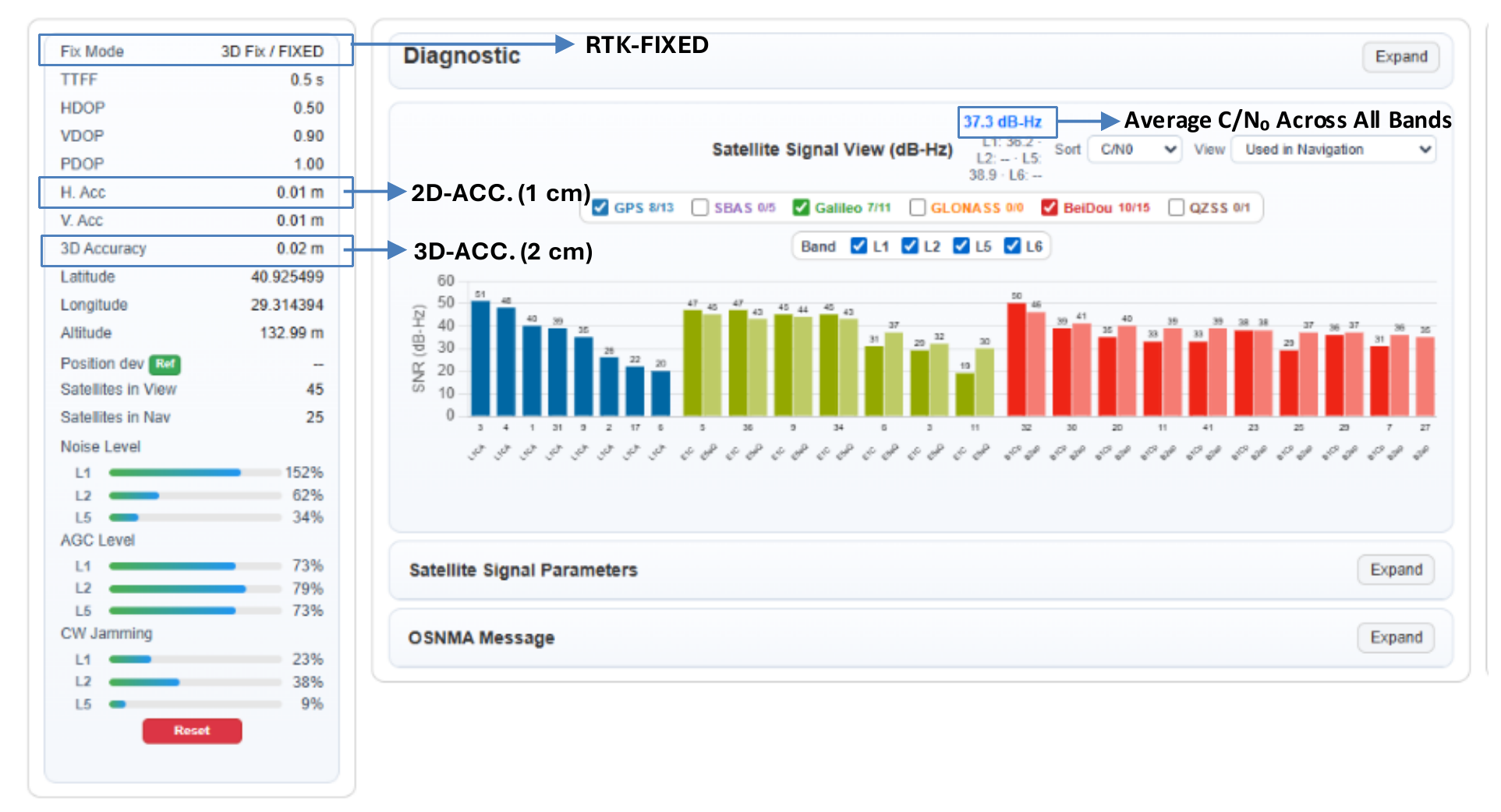
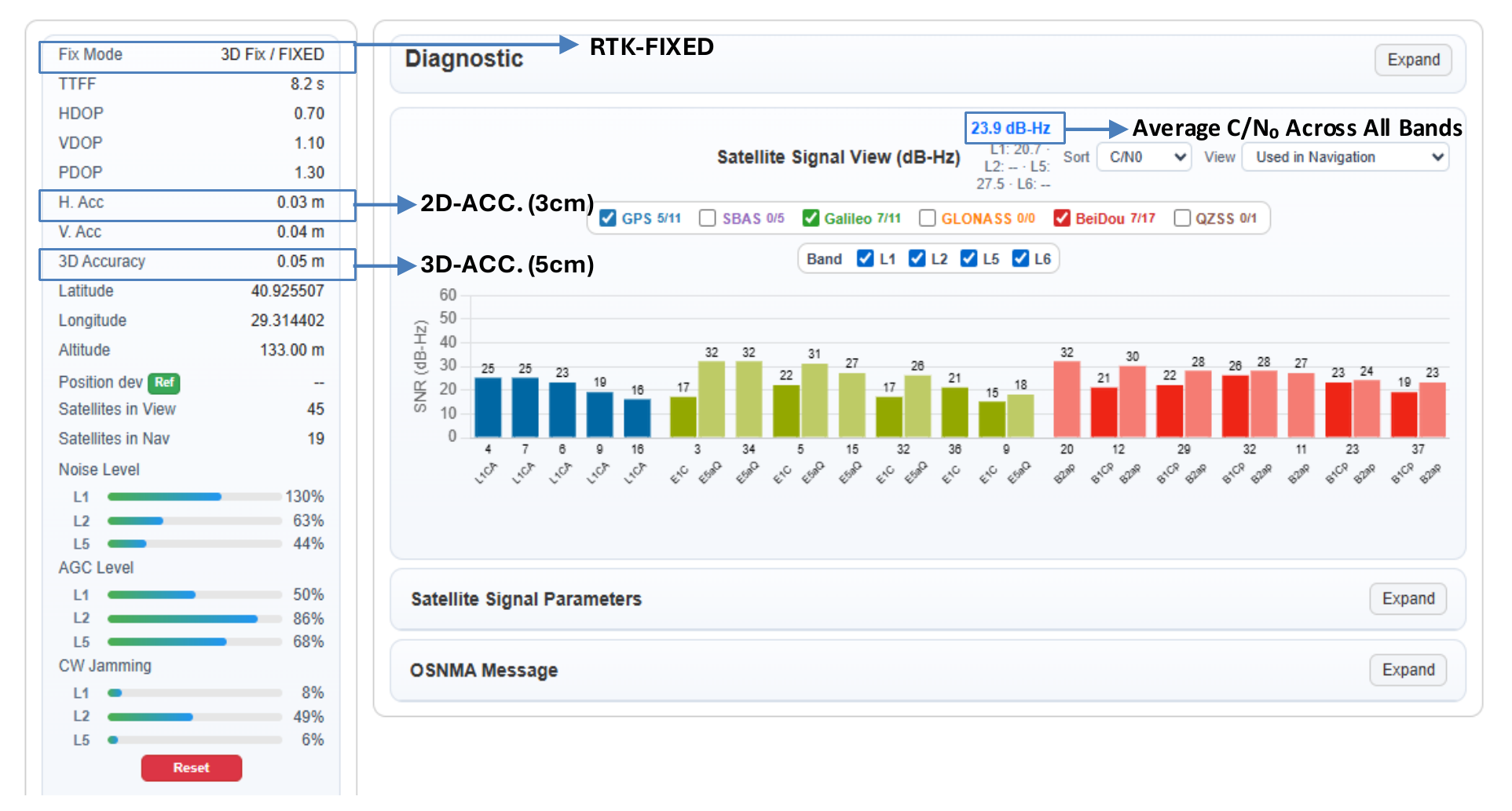
The RTK positioning performance of the HEDGE-8016 was evaluated under interference-free and spatially distributed interference conditions to assess its multi-band GNSS robustness. Figure 6 demonstrates stable RTK-FIXED operation with centimeter-level accuracy under interference-free conditions, while Figure 7 presents the performance under severe dual-band L1/L5 interference.
Despite the challenging RF environment, the HEDGE-8016 maintained an RTK-FIXED solution with centimeter-level accuracy. Multi-band GNSS measurements enabled reliable high-precision positioning under interference, demonstrating the resilience of the HEDGE-8016 and the effectiveness of its multi-band CRPA architecture. Further details are available in the HEDGE Multi-Band CRPA Solution White Paper.
6. Conclusion
RTK positioning delivers centimeter-level accuracy (1–2 cm) in real time, compared to meter-level accuracy of standard GNSS positioning. That precision creates a strict requirement: the antenna and GNSS receiver front end must not introduce unmodeled phase changes as the interference environment evolves.
Although conventional GNSS CRPAs can suppress spatially distributed interferences, continuously varying complex weights and inter-channel phase biases can alter the composite phase response and effective phase center of the antenna, potentially preventing reliable RTK resolution.
The HEDGE CRPA architecture allows its adaptive weights to form and reposition interference nulls without compromising carrier-phase integrity. A proprietary phase-stabilization network compensates for phase disturbances caused by null-forming array processing.
Experimental results demonstrate that the architecture can maintain high-accuracy navigation performance under severe multi-source interference. HEDGE CRPA architecture therefore preserves centimeter-level RTK positioning in interference environments where conventional CRPA architectures experience loss of RTK resolution.
To learn more, visit www.edgemicrowave.com and follow us on LinkedIn for the latest updates.